Vinny has always loved things that go round and round -- wheels, windmills, you name it. He was terrified of the clothes washer for a while, because it went "boom boom boom" when the load was unbalanced and the noise scared him, but he has since overcome his fear and added washers to the list of fascinating things that go round and round.
He is so interested in washers that he has lately spent the majority of his computer time watching washer repair videos, which he can now quote word-for-word. (If there's something wrong with your washer, ask him what to do before you call a repairperson!) He always wants to help load and run the clothes washer, which is great except that while he is also excited to operate the dryer, he's much less interested in folding and putting away the clothes.
He also wants to play clothes washer. How do you play clothes washer, you may be asking? Well, he turns around and around, saying "ratta ratta ratta" as if he is the agitator in the center of the basket of a top-loading washer.
Yesterday he declared that he wanted to buy a washing machine and install it in the bathroom so that he can play with it. If it weren't for the space problems, I would be happy to buy him a cheap used one to tinker with! Instead, Jeff promised him that if we ever needed to get a new washer, he could help pick it out.
Another obsession of his is fans. He has enjoyed watching videos of fans on YouTube for years and years. There are people who have fan collections and post videos of them. There are videos by kids and adults alike. Vinny was especially inspired by the children with fan collections and began a collection of his own. He spends the money he gets for good behavior on new fans. And once, when he did something we were especially proud of, Jeff took him to Kmart and let him pick any toy he wanted. What did he select? A box fan, one with two knobs!
They have show and tell at his school every Monday and Friday, and every time, he has brought a different fan to share. Some of the kids are not interested in his fans, but other ones have developed an interest in fans thanks to him. In fact, we went to one of his classmates' birthday party a few weeks ago and the birthday girl had told her mother that Vinny had too many fans and should giver her one of his fans for her birthday. We gave her a brand-new fan of her own and it was like the best gift ever.
For Vinny's birthday, Jeff found an antique desk fan on eBay. We know he will love it. If only there were a small washer that we could get him (beyond the small pink toy we bought to try to help him overcome his fear of washers).
Monday, September 26, 2011

Sunday, September 25, 2011
Computational Conversations
(based on actual conversations I have had with domain scientists...)
Solving a scientific problem? I can help!
Is it a partial differential equation? I know something about that. I've solved Schrödinger's equation in many forms. Advection and diffusion I know well. Choose your finiteness: finite elements, finite differences, or finite volumes? Each one has its own advantages and pitfalls.
Linear algebra? Use an optimized BLAS library, not the reference library! Our vendor has a group of applied mathematicians who developed these math libraries just for you. Don't let all their effort go to waste! Eigenvalues -- you don't need to orthogonalize at every step, just every so often. Maybe it will require a few more iterations, but the iterations will be so much cheaper...
Optimization? Yes! Finally something I am an expert in! Okay, so what type of problem are you solving? Is it convex? Is the objective function cheap to evaluate? How many parameters? Is it a mixed-integer program? Actually, I think your problem could be reformulated as a combinatorial optimization problem and we could try an evolutionary algorithm...
Oh, you meant code optimization. Yes, I can do that too. See these loops? Since it's Fortran, we need to reorder the loops so that the array is accessed by its first index in the innermost loop, not its second. See, we just got a 4x performance boost just by swapping these indices. Okay, let's change this array to a function, because it is easily calculated and the function can be inlined whereas that memory lookup can't. And let's eliminate these "if" statements by dividing this loop into two parts.
Your job fails at 120,000 MPI processes, but not below that? What happens when it fails? How long does it take to get to the point of failure? What is the code doing when it fails? Does it always happen in the same place? Let me ask my sysadmin colleague to look in the top-secret log files that only they can view...
Does this computation depend on that one, or can it be done in any order? Is there any reason to keep this data after initialization? What if we used this framework? Asynchronously spawning new tasks would implicitly load balance this algorithm. Your algorithm is not scalable. The synchronizing you do will be a huge bottleneck as you scale up. It may work okay now, but at the petascale or beyond there will be scalability issues coming out of the woodwork, things even beyond this synchronization issue. Trust me, I have seen this happen even in my own codes. Let my pain be your gain!
I may not be a scientist in your field, but I know a lot of things that can help you. I've boosted the performance of codes by a factor of two with a single keystroke. I may not have seen your problem before, but I've seen something like it.
Solving a scientific problem? I can help!
Is it a partial differential equation? I know something about that. I've solved Schrödinger's equation in many forms. Advection and diffusion I know well. Choose your finiteness: finite elements, finite differences, or finite volumes? Each one has its own advantages and pitfalls.
Linear algebra? Use an optimized BLAS library, not the reference library! Our vendor has a group of applied mathematicians who developed these math libraries just for you. Don't let all their effort go to waste! Eigenvalues -- you don't need to orthogonalize at every step, just every so often. Maybe it will require a few more iterations, but the iterations will be so much cheaper...
Optimization? Yes! Finally something I am an expert in! Okay, so what type of problem are you solving? Is it convex? Is the objective function cheap to evaluate? How many parameters? Is it a mixed-integer program? Actually, I think your problem could be reformulated as a combinatorial optimization problem and we could try an evolutionary algorithm...
Oh, you meant code optimization. Yes, I can do that too. See these loops? Since it's Fortran, we need to reorder the loops so that the array is accessed by its first index in the innermost loop, not its second. See, we just got a 4x performance boost just by swapping these indices. Okay, let's change this array to a function, because it is easily calculated and the function can be inlined whereas that memory lookup can't. And let's eliminate these "if" statements by dividing this loop into two parts.
Your job fails at 120,000 MPI processes, but not below that? What happens when it fails? How long does it take to get to the point of failure? What is the code doing when it fails? Does it always happen in the same place? Let me ask my sysadmin colleague to look in the top-secret log files that only they can view...
Does this computation depend on that one, or can it be done in any order? Is there any reason to keep this data after initialization? What if we used this framework? Asynchronously spawning new tasks would implicitly load balance this algorithm. Your algorithm is not scalable. The synchronizing you do will be a huge bottleneck as you scale up. It may work okay now, but at the petascale or beyond there will be scalability issues coming out of the woodwork, things even beyond this synchronization issue. Trust me, I have seen this happen even in my own codes. Let my pain be your gain!
I may not be a scientist in your field, but I know a lot of things that can help you. I've boosted the performance of codes by a factor of two with a single keystroke. I may not have seen your problem before, but I've seen something like it.
Saturday, September 24, 2011
Radio Silence
Hello world!
I have found that when I am under a lot of stress, I tend to just retreat inside myself. I don't want to talk about the stress and I can't think of anything else to talk about, so I just get quiet.
The past two months have been that way for me. There has been a lot of stress. I have retreated and remained silent.
The stress is still there but I am trying to think about other things to talk about. Please bear with me; my creative juices do not flow well under these circumstances.
I have found that when I am under a lot of stress, I tend to just retreat inside myself. I don't want to talk about the stress and I can't think of anything else to talk about, so I just get quiet.
The past two months have been that way for me. There has been a lot of stress. I have retreated and remained silent.
The stress is still there but I am trying to think about other things to talk about. Please bear with me; my creative juices do not flow well under these circumstances.
Friday, July 15, 2011
Leaf Beliefs
My younger sister is a professor of religion, who focuses on environmental ethics, so she has been really interested in hearing what I am feeling about the ethical implications of owning and operating an electric car. Since I have had it for a grand total of nine days, I of course feel inherently qualified to discuss all the ethical implications of the Nissan Leaf. (*grin*)
As I said before, I felt a strong ethical impulse to buy the car, and it went further than simple carbon footprint reduction. I have enough disposable income that I can afford more than just the basic necessities, and I like to choose ethical ways in which to spend my money. This is why I buy a share in a local farm -- I support the local economy and get tasty fruits and veggies to eat. I also want to spend my money to encourage more good works, which is why I donate to good causes (e.g., GLBT equality).
I feel that buying a Nissan Leaf helped me to further both these goals. It is ethical to avoid buying gasoline -- the instability in the Middle East is fueled by our insatiable appetite for petroleum. (Of course there are ethical issues with the way that electric power is generated, but I think this is the lesser of two evils.) By being one of the earliest adopters of the technology, I am monetarily encouraging a company that is taking a bold ethical step.
My sister also asked me whether I felt "less-polluting joy" every time I drove the car. I told her that yes, I do feel a certain sense of joy every time I get into my coal-powered car. (Most of our electricity comes from coal.) Sometimes I just feel like, "Oh hey, I can drive anywhere I want! I am not polluting at all! I will never walk anywhere again!"
Except, yeah, I'm still polluting. It's not coming out of my tailpipe. It's coming out of a smokestack instead. While it is less than what would come from a tailpipe, even if it's 100% coal powered, that doesn't mean you are absolved of responsibility for pollution.
But since it is hard to see those emissions, it is hard to feel guilty when you step on the pedal and accelerate a little more than you would have otherwise. And it does accelerate so smoothly and so instantaneously...
As I said before, I felt a strong ethical impulse to buy the car, and it went further than simple carbon footprint reduction. I have enough disposable income that I can afford more than just the basic necessities, and I like to choose ethical ways in which to spend my money. This is why I buy a share in a local farm -- I support the local economy and get tasty fruits and veggies to eat. I also want to spend my money to encourage more good works, which is why I donate to good causes (e.g., GLBT equality).
I feel that buying a Nissan Leaf helped me to further both these goals. It is ethical to avoid buying gasoline -- the instability in the Middle East is fueled by our insatiable appetite for petroleum. (Of course there are ethical issues with the way that electric power is generated, but I think this is the lesser of two evils.) By being one of the earliest adopters of the technology, I am monetarily encouraging a company that is taking a bold ethical step.
My sister also asked me whether I felt "less-polluting joy" every time I drove the car. I told her that yes, I do feel a certain sense of joy every time I get into my coal-powered car. (Most of our electricity comes from coal.) Sometimes I just feel like, "Oh hey, I can drive anywhere I want! I am not polluting at all! I will never walk anywhere again!"
Except, yeah, I'm still polluting. It's not coming out of my tailpipe. It's coming out of a smokestack instead. While it is less than what would come from a tailpipe, even if it's 100% coal powered, that doesn't mean you are absolved of responsibility for pollution.
But since it is hard to see those emissions, it is hard to feel guilty when you step on the pedal and accelerate a little more than you would have otherwise. And it does accelerate so smoothly and so instantaneously...
Monday, July 11, 2011
More About Leaf
I have been enjoying the new car immensely. Scarlet drives like a dream. This weekend my dad came for a visit and I took him for a spin in it. He was very interested in how it all worked.
I have discovered some more cool features on the owners' portal website. First, you can plan routes, making sure that you have enough range to do the entire route, and then send those routes to the car's navigation system. Tomorrow I have to go somewhere unfamiliar for work, so I availed myself of this feature. I'll let you know how it turns out.
Second, you remember the little trees you can earn for driving efficiently? Well, it turns out that it records the number of trees you earn and then rates your performance. I apparently drive okay but there is a lot of room for improvement. I am ranked number eight-hundred-something out of all the drivers. Number one gets nearly an order of magnitude more miles per kilowatt than I do. I don't know what I'm doing wrong or they are doing right.
I have discovered some more cool features on the owners' portal website. First, you can plan routes, making sure that you have enough range to do the entire route, and then send those routes to the car's navigation system. Tomorrow I have to go somewhere unfamiliar for work, so I availed myself of this feature. I'll let you know how it turns out.
Second, you remember the little trees you can earn for driving efficiently? Well, it turns out that it records the number of trees you earn and then rates your performance. I apparently drive okay but there is a lot of room for improvement. I am ranked number eight-hundred-something out of all the drivers. Number one gets nearly an order of magnitude more miles per kilowatt than I do. I don't know what I'm doing wrong or they are doing right.
Thursday, July 07, 2011
All About Leaf
I am pleased to report that as of Tuesday afternoon, I am a proud owner of a Nissan Leaf! We named her Scarlet, because she is a beautiful red. The car is a she, because it is awesome, innovative, and pioneering.
I'm not usually one to just jump in and be an early adopter of technology. After all, I've had a text-enabled cellphone for less than a year. But I feel so strongly that electric vehicles are the only thing that will help our transportation-related carbon emissions to cease, that I wanted to support the effort.
I am fortunate enough that I have a good job that allows us to support ourselves comfortably and still afford this car. It is not cheap. There are some tax breaks (including a $7500 federal income tax rebate) but that only goes so far. The cost of charging up is a lot less than the corresponding cost of gasoline, but even then, since I drive so little (the Beetle just crossed the 35,000-mile threshold) this saves me maybe $40 per month. I anticipate that we will take this car on errands around town, instead of our other car, so we should save a little more than that. Still, less than $100 in savings.
Anyhow, onward to the car!

This is Scarlet, parked in our carport. You can see the home charging station installed by two electricians beginning at 7:30 am this past Tuesday. I had to get the charger installed before I was allowed to bring home the car.

Another view of the car.

Check out that headlight. It has a fin on it, for aerodynamics purposes I assume.

Another view, trying to show that fin.

I think the fin is pretty clear in this photo. Maybe the cars of the 1950's had something going for them!

A view from the driver's seat. That little window between the side and the windshield doesn't buy you much.

Here's a view across to the other side.

Between the seats. That is one tiny shifter as we will see later.

The console can show a cool map telling you how far you can go without running out of charge, and a bunch of other things.

To start the car, depress the brake pedal and push the power button!

Here's the view you get: On the left is the battery temperature. On the right is the battery charge and the number of miles it estimates I can go. At the top center is a gauge for how much power I am drawing (or regenerating). In the center it tells me how long it will take to recharge at various voltages, and the odometer.

At the top, above the steering wheel, you can see the speedometer in the center. On the right is a clock and temperature gauge, and on the left is a gauge telling you how efficiently you are driving, and rewarding you for your efficient driving by generating little trees. The more trees, the better. Unfortunately, they all get reset every time you turn the car off.

Here I am shifting into reverse by moving the shifter to the left and forward. You shift into drive by going left and backward. Of course this all makes perfect sense! I double check which gear I'm in every time before I release the brake because I am so confused.

When you put it in reverse, a rear-view camera comes up on the console. This is handy because the rear window is tiny. The stripes are not part of my driveway decor; they represent distance.

A little light reading that came with the car. I've made it through one of those books so far!

So I made it to work now. I am a cheapskate and since my workplace provides free charging, I am going to take advantage of it! So, I pull the lever to open the charging compartment, located on the front of the car just under the place where you open the hood.

Here's what it looks like when it is open. On the right is where you plug in the 240V charger, which is what we have at home and at work. The one on the left is for the 480V charging stations, which do not actually exist yet, but when they do, I will be able to drive this car to see my Dad, with a short stop to recharge on the way there.

I opened the cover for the 240V socket, and this is what it looks like.

Here is the charging station, which looks almost exactly like what I have at home...

...except that, for this charger, you have to activate it with your magic card. The electrons are free in exchange for tracking my usage information.

It's ready to go...

So I remove the plug from the dock...

...start plugging it in.

... and I push it in until I hear a click...

It's in!

We are charging!

A view of the trunk. It is pretty big. That black bag is a 120V trickle charger that you can plug into a regular wall outlet in a pinch. There is no spare tire, but there is a tire repair kit in the left wheel well.

As you can see, I am not the only person with a Leaf at work. The Head Honcho has a Red one like mine, and several other VIPs have them as well. My car schmoozes with other cars belonging to important people!

Nissan has an owners' portal, where you can check the status of your car. You can also program it to start the climate control while plugged in, saving your battery from doing all that work. It's handy if you want your car to be comfortable just before you leave work, for example.

Here I set the timer to start cooling the car at 3:45 this afternoon...

...and it's set.

Huh? There's a message on my cellphone!

It's from Scarlet, telling me that the vehicle's status has been updated.

It's 3:45 and the AC is on! Nice of Scarlet to let me know!

Time to go home! If you get in the car while it is still plugged in, you will see this warning on the dash. It won't let you go anywhere while still plugged in, but as I found out this afternoon because I was too obsessed with snapping pictures to pay enough attention, it will let you go with the charging door still open.

I unplug the charger, and notice as I am putting it back on the dock that I have received a text message:

The climate control stopped when I unplugged it.
I hopped into the car and came home. It is really a great car. It has good acceleration and other than being so quiet, it really seems just like a regular car. In fact, it is so quiet that at speeds of 19 mph or below, it generates noise so that pedestrians can hear it coming. Another interesting thing is that because it is so quiet, you can hear a lot of noise coming from the other cars around you. At stoplights I hear everyone else's music.
Anyhow, it is great and I am really enjoying the car. I hope you enjoyed a vicarious taste of this awesome car!
I'm not usually one to just jump in and be an early adopter of technology. After all, I've had a text-enabled cellphone for less than a year. But I feel so strongly that electric vehicles are the only thing that will help our transportation-related carbon emissions to cease, that I wanted to support the effort.
I am fortunate enough that I have a good job that allows us to support ourselves comfortably and still afford this car. It is not cheap. There are some tax breaks (including a $7500 federal income tax rebate) but that only goes so far. The cost of charging up is a lot less than the corresponding cost of gasoline, but even then, since I drive so little (the Beetle just crossed the 35,000-mile threshold) this saves me maybe $40 per month. I anticipate that we will take this car on errands around town, instead of our other car, so we should save a little more than that. Still, less than $100 in savings.
Anyhow, onward to the car!

This is Scarlet, parked in our carport. You can see the home charging station installed by two electricians beginning at 7:30 am this past Tuesday. I had to get the charger installed before I was allowed to bring home the car.

Another view of the car.

Check out that headlight. It has a fin on it, for aerodynamics purposes I assume.
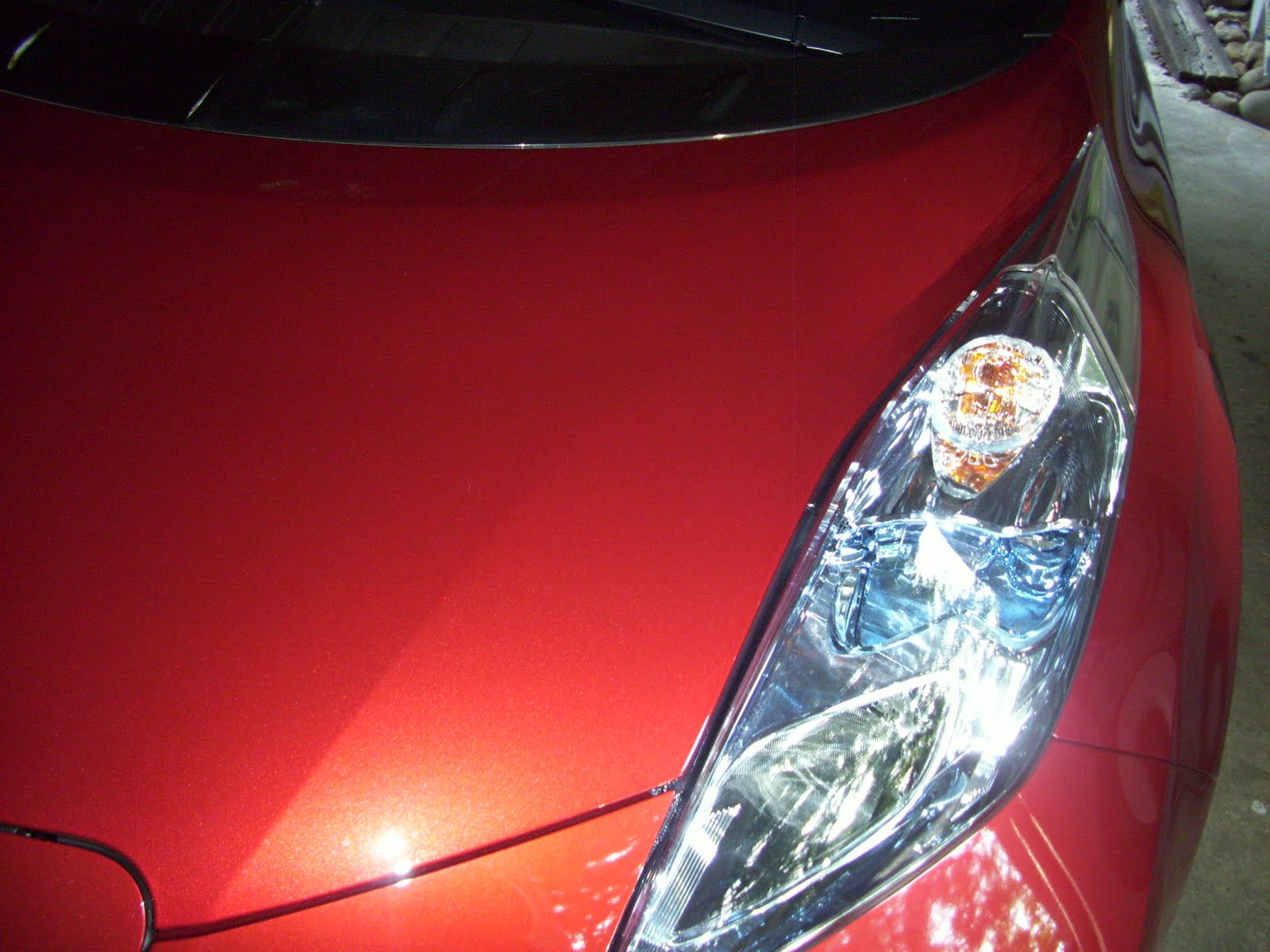
Another view, trying to show that fin.

I think the fin is pretty clear in this photo. Maybe the cars of the 1950's had something going for them!

A view from the driver's seat. That little window between the side and the windshield doesn't buy you much.

Here's a view across to the other side.

Between the seats. That is one tiny shifter as we will see later.

The console can show a cool map telling you how far you can go without running out of charge, and a bunch of other things.

To start the car, depress the brake pedal and push the power button!

Here's the view you get: On the left is the battery temperature. On the right is the battery charge and the number of miles it estimates I can go. At the top center is a gauge for how much power I am drawing (or regenerating). In the center it tells me how long it will take to recharge at various voltages, and the odometer.

At the top, above the steering wheel, you can see the speedometer in the center. On the right is a clock and temperature gauge, and on the left is a gauge telling you how efficiently you are driving, and rewarding you for your efficient driving by generating little trees. The more trees, the better. Unfortunately, they all get reset every time you turn the car off.

Here I am shifting into reverse by moving the shifter to the left and forward. You shift into drive by going left and backward. Of course this all makes perfect sense! I double check which gear I'm in every time before I release the brake because I am so confused.

When you put it in reverse, a rear-view camera comes up on the console. This is handy because the rear window is tiny. The stripes are not part of my driveway decor; they represent distance.

A little light reading that came with the car. I've made it through one of those books so far!

So I made it to work now. I am a cheapskate and since my workplace provides free charging, I am going to take advantage of it! So, I pull the lever to open the charging compartment, located on the front of the car just under the place where you open the hood.
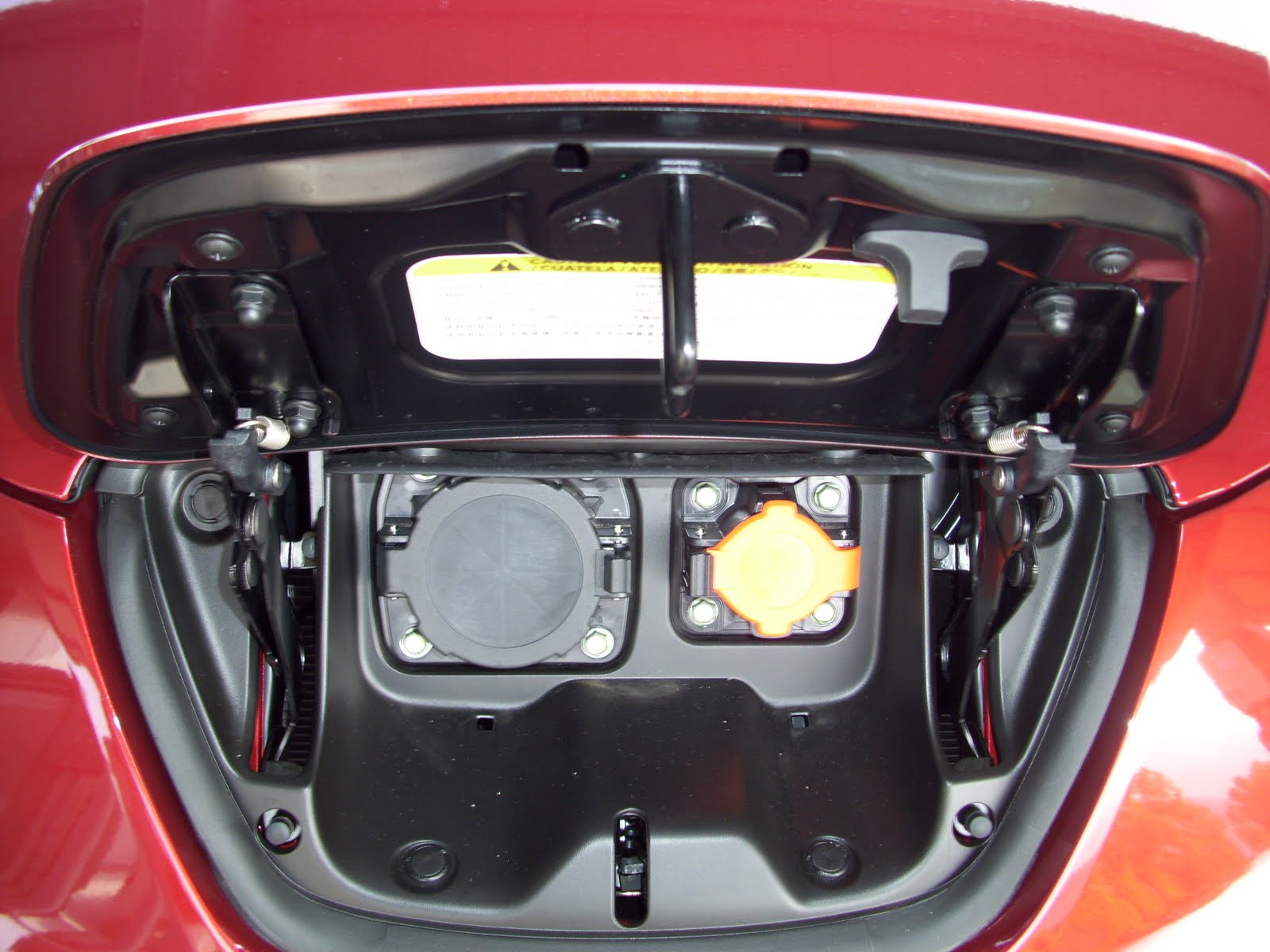
Here's what it looks like when it is open. On the right is where you plug in the 240V charger, which is what we have at home and at work. The one on the left is for the 480V charging stations, which do not actually exist yet, but when they do, I will be able to drive this car to see my Dad, with a short stop to recharge on the way there.

I opened the cover for the 240V socket, and this is what it looks like.

Here is the charging station, which looks almost exactly like what I have at home...

...except that, for this charger, you have to activate it with your magic card. The electrons are free in exchange for tracking my usage information.

It's ready to go...

So I remove the plug from the dock...

...start plugging it in.

... and I push it in until I hear a click...

It's in!

We are charging!

A view of the trunk. It is pretty big. That black bag is a 120V trickle charger that you can plug into a regular wall outlet in a pinch. There is no spare tire, but there is a tire repair kit in the left wheel well.

As you can see, I am not the only person with a Leaf at work. The Head Honcho has a Red one like mine, and several other VIPs have them as well. My car schmoozes with other cars belonging to important people!

Nissan has an owners' portal, where you can check the status of your car. You can also program it to start the climate control while plugged in, saving your battery from doing all that work. It's handy if you want your car to be comfortable just before you leave work, for example.

Here I set the timer to start cooling the car at 3:45 this afternoon...

...and it's set.

Huh? There's a message on my cellphone!

It's from Scarlet, telling me that the vehicle's status has been updated.

It's 3:45 and the AC is on! Nice of Scarlet to let me know!

Time to go home! If you get in the car while it is still plugged in, you will see this warning on the dash. It won't let you go anywhere while still plugged in, but as I found out this afternoon because I was too obsessed with snapping pictures to pay enough attention, it will let you go with the charging door still open.

I unplug the charger, and notice as I am putting it back on the dock that I have received a text message:

The climate control stopped when I unplugged it.
I hopped into the car and came home. It is really a great car. It has good acceleration and other than being so quiet, it really seems just like a regular car. In fact, it is so quiet that at speeds of 19 mph or below, it generates noise so that pedestrians can hear it coming. Another interesting thing is that because it is so quiet, you can hear a lot of noise coming from the other cars around you. At stoplights I hear everyone else's music.
Anyhow, it is great and I am really enjoying the car. I hope you enjoyed a vicarious taste of this awesome car!
Friday, June 24, 2011
Queen of Nerdingham
In case the Ph.D. in computer science was not enough of a giveaway on this, let me just say that I am a huge nerd. I take pride in this fact, actually, but I have not always felt this way.
Growing up, I was made fun of a lot because I was a nerd. I felt really bad about being a nerd, but there was nothing I could do about it -- I just love to think, learn new things, and exercise my brain.
I didn't have the perspective then that I have now. I didn't see that knowledge, and the ability to analyze and sort through it, is power; that freedom lies between the ears; or that the strength of my mind and the determination of my will could save me from despair.
Today, I am grateful for my nerd traits. My love of thinking and learning enables me to solve problems of all kinds. It allows me to function well in the world. And it helps me make a really good living and support my family.
Growing up, I was made fun of a lot because I was a nerd. I felt really bad about being a nerd, but there was nothing I could do about it -- I just love to think, learn new things, and exercise my brain.
I didn't have the perspective then that I have now. I didn't see that knowledge, and the ability to analyze and sort through it, is power; that freedom lies between the ears; or that the strength of my mind and the determination of my will could save me from despair.
Today, I am grateful for my nerd traits. My love of thinking and learning enables me to solve problems of all kinds. It allows me to function well in the world. And it helps me make a really good living and support my family.
Thursday, June 23, 2011
I'm a Winner!
Yesterday I found out that the project I worked on as a postdoc won a major honor. It wasn't until someone emailed me a congratulatory note that I realized that my name had been included in the nomination as well!
I spent about an hour laughing about the unexpected honor. A friend at work told me that I should be proud and I deserved the recognition.
I don't feel like I do, but that is mostly because I have not worked on that project for several years. But when I think about it, I actually did make a substantial contribution: although they don't use the algorithms I developed, they do still use the framework I developed for them.
I spent about an hour laughing about the unexpected honor. A friend at work told me that I should be proud and I deserved the recognition.
I don't feel like I do, but that is mostly because I have not worked on that project for several years. But when I think about it, I actually did make a substantial contribution: although they don't use the algorithms I developed, they do still use the framework I developed for them.
Wednesday, June 22, 2011
Fostering: Continuing Education
EcoGeoFemme asks:
Do you feel like the training/continuing ed is useful, or just red tape? Have you learned anything from it?
Good question! In principle, the training and continuing education is a great idea. I can tell you from my brief experience so far, we can use all the help we can get! But I actually have not yet taken a class so I don't know yet whether it is useful. But there is one scheduled for sometime next month so I will update you on what I think.
Have any questions about foster parenting? Feel free to leave them in the comments, and I'll answer as best I can!
Do you feel like the training/continuing ed is useful, or just red tape? Have you learned anything from it?
Good question! In principle, the training and continuing education is a great idea. I can tell you from my brief experience so far, we can use all the help we can get! But I actually have not yet taken a class so I don't know yet whether it is useful. But there is one scheduled for sometime next month so I will update you on what I think.
Have any questions about foster parenting? Feel free to leave them in the comments, and I'll answer as best I can!
Thursday, June 09, 2011
Fostering: The Home Study
Ginger asked about the questions they ask during the home study.
The home study has two parts: first, examining your home to make sure that it is safe and has enough room for a child or children; and second, interviews with the family members.
After she first arrived, I gave the social worker a tour of our house. I took her to every room, told her how we used each room, and pointed out the room where the child would stay. She made sure that we had sufficient smoke and carbon monoxide detectors, that all our medications were locked away, and the house and yard were safe in general. There was a whole checklist of requirements, including things that did not apply to us (e.g., swimming pools must be fenced in). We also had to have a bedroom that the child could sleep in -- they don't necessarily need a room to themselves, but it needs to be a bedroom and not a hallway or a shed(!).
Then, she interviewed me. I was asked about my childhood and my general biographical history, my parents and siblings, how my parents disciplined me, the current status of my relationships with family members, my educational and employment history, my current job and how I feel about it, my religious beliefs and my openness to those with differing beliefs, how I handle anger, how I discipline Vinny, my relationship with Jeff. I was also asked about any drug addicts or alcoholics in my immediate and extended families, and about Jeff's history with substances. And at the end, I was asked what my goals were and what sort of foster care I would be interested in doing, and what types of children I would want to have.
On a second visit, Jeff was interviewed, and the questions were about the same. The social worker interviewed Vinny, too, asking him what kinds of kids he would like to have stay with us.
After the interviews, the social worker wrote up a document about our house and about us, and sent it to us to revise and correct. When we were satisfied that it was accurate, we signed a form to certify our approval and the home study process was complete!
In order to retain our license, we must have a home inspection annually, as well as stay current in CPR and First Aid certifications and receive 15 hours of continuing education each year. Luckily the profiles of us will remain valid and we won't have to answer all those questions again unless we let the license expire!
Have any questions about foster parenting? Feel free to leave them in the comments, and I'll answer as best I can!
The home study has two parts: first, examining your home to make sure that it is safe and has enough room for a child or children; and second, interviews with the family members.
After she first arrived, I gave the social worker a tour of our house. I took her to every room, told her how we used each room, and pointed out the room where the child would stay. She made sure that we had sufficient smoke and carbon monoxide detectors, that all our medications were locked away, and the house and yard were safe in general. There was a whole checklist of requirements, including things that did not apply to us (e.g., swimming pools must be fenced in). We also had to have a bedroom that the child could sleep in -- they don't necessarily need a room to themselves, but it needs to be a bedroom and not a hallway or a shed(!).
Then, she interviewed me. I was asked about my childhood and my general biographical history, my parents and siblings, how my parents disciplined me, the current status of my relationships with family members, my educational and employment history, my current job and how I feel about it, my religious beliefs and my openness to those with differing beliefs, how I handle anger, how I discipline Vinny, my relationship with Jeff. I was also asked about any drug addicts or alcoholics in my immediate and extended families, and about Jeff's history with substances. And at the end, I was asked what my goals were and what sort of foster care I would be interested in doing, and what types of children I would want to have.
On a second visit, Jeff was interviewed, and the questions were about the same. The social worker interviewed Vinny, too, asking him what kinds of kids he would like to have stay with us.
After the interviews, the social worker wrote up a document about our house and about us, and sent it to us to revise and correct. When we were satisfied that it was accurate, we signed a form to certify our approval and the home study process was complete!
In order to retain our license, we must have a home inspection annually, as well as stay current in CPR and First Aid certifications and receive 15 hours of continuing education each year. Luckily the profiles of us will remain valid and we won't have to answer all those questions again unless we let the license expire!
Have any questions about foster parenting? Feel free to leave them in the comments, and I'll answer as best I can!
Tuesday, June 07, 2011
Fostering: Q&A
GMP asked: From what you wrote it seems that prospective foster parents are quite thoroughly checked. In contrast, there are all these horror stories about foster care abuse cases in the news and TV shows -- do you feel they are grossly exaggerated?
I think there are varying degrees of abuse and mistreatment that occur in the foster care system, and the worst ones get sensationalized by the media. The reasons for abuse and mistreatment in the foster care system are many.
First, foster parents are human beings, just like everyone else. We all make mistakes with our biological children, and it is even harder to do the right thing every time with a child you don't know very well. Foster children, who are justifiably hurting and scared, can react in very unexpected ways and really try your patience. So if you are not well prepared or having a particularly bad day, you might reach the end of your rope before you know what happened.
Second, a lot of the people who are attracted to becoming foster parents had bad childhoods themselves. They want to make up for their own bad childhoods by providing an abused or neglected child with the care they themselves could have used as a child. While this is certainly a noble motivation, the foster parent's own childhood issues can result in them having a limited skillset when it comes to rearing children. Couple this limited skillset with children who test your mettle and you can really have an explosive environment.
Third, there are evil people who want to become foster parents for the purpose of exploiting children. The successful ones do not have criminal records and they have sufficient social skills that they can pass the home study process without tipping anyone off to their psychopathology. In our classes, our teacher told us about a case where a man who did not (yet) have a criminal record became a foster parent for the sole purpose of grooming teenage girls so he could sexually abuse them. Luckily they caught him before he could do much damage.
On my flight out of Alaska, I was seated next to an Alaskan foster mom. We talked quite a bit, and compared notes about the foster care systems in our states. The Tennessee system seems quite a bit more generous than the Alaska system, despite Tennessee's relative poverty as a state. We receive more money to take care of the kids (sad, considering the extremely high cost of living in Alaska), and they do not receive respite care. Our kids receive an allowance of $1/day, money that belongs to them, whereas Alaska's kids do not receive an allowance. Also, Tennessee will pay for college or vocational training for youngsters who age out of the foster system, but Alaska does not.
I think this illustrates pretty clearly how different each state's system is. That's why it seems to me that in some states the rules are more lax than in others, and there is more abuse within the system. Florida is a state that seems to have a notoriously bad foster care system. I'm sure this is due to the fact that the social workers are overworked and lack the resources to give all the children in the system the care that they need, and some end up falling through the cracks.
But even in the best systems, there will be mistakes and people get licensed who should not be. And being a foster parent is hard! I can understand how the frustration of it can lead people to make bad parenting choices out of desperation. It's not an excuse but it is an explanation.
Have any questions about foster parenting? Feel free to leave them in the comments, and I'll answer as best I can!
I think there are varying degrees of abuse and mistreatment that occur in the foster care system, and the worst ones get sensationalized by the media. The reasons for abuse and mistreatment in the foster care system are many.
First, foster parents are human beings, just like everyone else. We all make mistakes with our biological children, and it is even harder to do the right thing every time with a child you don't know very well. Foster children, who are justifiably hurting and scared, can react in very unexpected ways and really try your patience. So if you are not well prepared or having a particularly bad day, you might reach the end of your rope before you know what happened.
Second, a lot of the people who are attracted to becoming foster parents had bad childhoods themselves. They want to make up for their own bad childhoods by providing an abused or neglected child with the care they themselves could have used as a child. While this is certainly a noble motivation, the foster parent's own childhood issues can result in them having a limited skillset when it comes to rearing children. Couple this limited skillset with children who test your mettle and you can really have an explosive environment.
Third, there are evil people who want to become foster parents for the purpose of exploiting children. The successful ones do not have criminal records and they have sufficient social skills that they can pass the home study process without tipping anyone off to their psychopathology. In our classes, our teacher told us about a case where a man who did not (yet) have a criminal record became a foster parent for the sole purpose of grooming teenage girls so he could sexually abuse them. Luckily they caught him before he could do much damage.
On my flight out of Alaska, I was seated next to an Alaskan foster mom. We talked quite a bit, and compared notes about the foster care systems in our states. The Tennessee system seems quite a bit more generous than the Alaska system, despite Tennessee's relative poverty as a state. We receive more money to take care of the kids (sad, considering the extremely high cost of living in Alaska), and they do not receive respite care. Our kids receive an allowance of $1/day, money that belongs to them, whereas Alaska's kids do not receive an allowance. Also, Tennessee will pay for college or vocational training for youngsters who age out of the foster system, but Alaska does not.
I think this illustrates pretty clearly how different each state's system is. That's why it seems to me that in some states the rules are more lax than in others, and there is more abuse within the system. Florida is a state that seems to have a notoriously bad foster care system. I'm sure this is due to the fact that the social workers are overworked and lack the resources to give all the children in the system the care that they need, and some end up falling through the cracks.
But even in the best systems, there will be mistakes and people get licensed who should not be. And being a foster parent is hard! I can understand how the frustration of it can lead people to make bad parenting choices out of desperation. It's not an excuse but it is an explanation.
Have any questions about foster parenting? Feel free to leave them in the comments, and I'll answer as best I can!
Wednesday, June 01, 2011
Making History
This morning we left for Illinois, to join my sister and should-be sister-in-law in making history. You see, today marks the beginning of civil unions in Illinois, and my sister and her better half are among the first to be joined in civil unity.
There's a big ceremony tomorrow morning in a Chicago park, in which couples from across the state will participate. The governor and the mayor will both speak. I am really excited to be a part of the festivities and I am also looking forward to the time we will spend together after the ceremony!
There's a big ceremony tomorrow morning in a Chicago park, in which couples from across the state will participate. The governor and the mayor will both speak. I am really excited to be a part of the festivities and I am also looking forward to the time we will spend together after the ceremony!
Tuesday, May 31, 2011
Alaskan Adventures
The thing I didn't mention in the previous post is that my business travel was to Alaska. There was a conference up there and afterwards, I stayed for a few days extra. My sister Rachel flew up from Vancouver to join me in exploring the Alaskan countryside.
We took a train from Fairbanks to Denali National Park, where we spent two days. One morning we had a wilderness tour in the park, which consisted of riding along the road in a bus with a tour guide, periodically stopping for pictures, especially when wildlife crossed our field of vision. We saw many animals, including moose, caribou, fox, and a lynx.

We also saw the dramatic Denali landscape,
 and Mount McKinley.

I took so many pictures, my camera ran out of battery power and I had to stop. I am not much of a picture-taking person, but I felt compelled to preserve the experience somehow.
For most of the rest of our time, we hiked around some trails at the entrance to the park, and admired the rushing glacial melt and the spectacular peaks around us.
 I was fascinated by all the ice on the ground, still melting.

The sun essentially did not set the whole time we were there -- at best it was twilight for a few short hours before the day began anew, so we had to draw the curtains tightly if we were to get any sleep.
It was a really amazing experience that words cannot begin to describe -- and neither can pictures. To be in a place so untouched by humans, so wild, so vast, so rugged -- it was a very emotional experience for me. I pretty much could not wipe the goofy grin off my face. I exclaimed at the amazing landscapes, the high mountain peaks, the wild animals. I felt so connected to the natural world -- more connected than ever before. I could see why people fall in love with Alaska and stay, despite the harsh conditions.
We took a train from Fairbanks to Denali National Park, where we spent two days. One morning we had a wilderness tour in the park, which consisted of riding along the road in a bus with a tour guide, periodically stopping for pictures, especially when wildlife crossed our field of vision. We saw many animals, including moose, caribou, fox, and a lynx.

We also saw the dramatic Denali landscape,


I took so many pictures, my camera ran out of battery power and I had to stop. I am not much of a picture-taking person, but I felt compelled to preserve the experience somehow.
For most of the rest of our time, we hiked around some trails at the entrance to the park, and admired the rushing glacial melt and the spectacular peaks around us.


The sun essentially did not set the whole time we were there -- at best it was twilight for a few short hours before the day began anew, so we had to draw the curtains tightly if we were to get any sleep.
It was a really amazing experience that words cannot begin to describe -- and neither can pictures. To be in a place so untouched by humans, so wild, so vast, so rugged -- it was a very emotional experience for me. I pretty much could not wipe the goofy grin off my face. I exclaimed at the amazing landscapes, the high mountain peaks, the wild animals. I felt so connected to the natural world -- more connected than ever before. I could see why people fall in love with Alaska and stay, despite the harsh conditions.
Wednesday, May 25, 2011
Business Travel
I am on business travel this week, at a conference. Overall, I am having a lot of fun. But there are moments that are not fun, especially for a woman business traveler in a male-dominated field. Over the past four days, I have had the following experiences:
- My supervisor's supervisor (hereafter referred to as Boss) and I were traveling on the same flights. Upon boarding the plane, I saw Boss was already on, so I made a comment to him about the legroom of his seat on the plane. His row-mate volunteered to trade seats with me in exchange for payment so I could sit next to Boss. I suggested he take it up with Boss, since he is richer than I am. The guy discounted monetary wealth as unimportant and waxed rhapsodic about happiness and the quality of life. At that point his words combined with the creepy vibes I'd been getting from him made me realize what type of payment he was thinking of, so I declined and disengaged from the conversation. My suspicions about his motives were confirmed when Boss told me the guy had invited us to join him in the airport lounge. (Hint: he was not interested in Boss's company.)
- Upon checking in at the hotel, I was asked if Boss and I were together. No, we are not. Also, he has kids who are my age.
- At a social event, I was mistaken for being married to another one of my colleagues. At least this person realized that I worked in the same place as my would-be spouse.
- Conference attendees get free breakfast at the hotel restaurant. This morning, I was charged for my breakfast, because I was obviously the spouse of one of the men I was eating with.
Saturday, May 07, 2011
Child Logic
Vinny has a cough and a bit of a cold, so yesterday morning I gave him some children's cough syrup before school. I went into the kitchen with the breakfast dishes and left him at the table to drink it down. While I was rinsing them off in the sink, I heard him say something to the effect of, "I wonder if this would help my nose, too."
When I returned to the dining room, I saw that his nose was all red -- the same color as the cough syrup. He had tried snorting some of it into his nose, I soon found out after he started screaming in pain! He kept telling me it was an accident -- but I think it was only an accident in the sense that it unexpectedly hurt him.
I helped him blow his nose and get all the cough syrup out. He was a little freaked out because he mistook the red dye in the cough syrup for blood -- probably because his nose was burning so badly. He whimpered for a while but eventually the pain went away. I stressed to him the importance of using medicines as they are supposed to be used. My doctor prescribed me some nasal spray in an effort to help my sad sniffer -- and I explained to Vinny that if I swallowed the medicine meant to be sniffed, I would be in trouble. Hopefully he understood, but even if he didn't, I suspect that this experience will warn him off of trying to snort any kind of illicit drugs!
When I returned to the dining room, I saw that his nose was all red -- the same color as the cough syrup. He had tried snorting some of it into his nose, I soon found out after he started screaming in pain! He kept telling me it was an accident -- but I think it was only an accident in the sense that it unexpectedly hurt him.
I helped him blow his nose and get all the cough syrup out. He was a little freaked out because he mistook the red dye in the cough syrup for blood -- probably because his nose was burning so badly. He whimpered for a while but eventually the pain went away. I stressed to him the importance of using medicines as they are supposed to be used. My doctor prescribed me some nasal spray in an effort to help my sad sniffer -- and I explained to Vinny that if I swallowed the medicine meant to be sniffed, I would be in trouble. Hopefully he understood, but even if he didn't, I suspect that this experience will warn him off of trying to snort any kind of illicit drugs!
Friday, May 06, 2011
Electric Car Update
I was supposed to get my Nissan Leaf this month. Unfortunately, with the earthquake in Japan (where this year's Nissan Leafs are being manufactured -- if you buy one next year it will be made in Tennessee) that date got pushed off until July. It is too bad because the last time I filled the tank of my Volkswagen Beetle it cost me more than $41 -- and that was with a $0.50/gallon discount.
But July is better than never, and really, there are so many worse things that earthquake did than delay the arrival of my car by two months, that I can't complain. It's just that I'm really excited about getting it so it kind of stinks that I won't get it as soon as I had thought.
But July is better than never, and really, there are so many worse things that earthquake did than delay the arrival of my car by two months, that I can't complain. It's just that I'm really excited about getting it so it kind of stinks that I won't get it as soon as I had thought.
Friday, April 29, 2011
Fostering: Transitioning Children
The next step is to match us with a child to foster. We are interested in adopting a child, so we are interested in finding a child whose parents rights have been terminated and is eligible for adoption. We also have certain preferences about the child. As I said earlier, we want a child who has a good chance of living on their own and being a contributing member of society with the help of our nurturing as they grow up. We did not care about the child's race or ethnicity, sexual orientation, or gender identity, and in fact I told the social worker that we would be a good family for a GLBT child.
She has found a child that may be a good fit for our family. As I said, I can't say anything about the child due to privacy issues, but I can tell you how the process is going to work.
Resource parents (foster parents) get two weekends a month free from doing foster care. During that time the child goes to another household for respite care. So, first we will be the respite care providers for this child for a while. Then, if that goes well, the child will transition to living with us as our foster child. And if that goes well, then after six months we will be allowed to adopt the child (with the child's permission if the child is above a certain age). Adoption will not be mentioned to the child until that last step, because we don't want to get the child's hopes up in case it doesn't work out.
There are other types of fostering that other foster parents do. As I mentioned, there is respite care, where you care for different children on the weekend so the regular week resource parents can get a break. There are also step-down resource families, who care for a child for a period of approximately six months, as the child transitions from a group home environment back to their family. And then there are emergency care resource parents, who take in children who have just been removed from their homes and are in need of a place to stay immediately. We considered doing the step-down program until an adoptable child came along, because the percentage of children in the foster care system who are adoptable is actually pretty low. But it seems like there is currently a child who might be a good fit in our family, so we are going to pursue that child.
She has found a child that may be a good fit for our family. As I said, I can't say anything about the child due to privacy issues, but I can tell you how the process is going to work.
Resource parents (foster parents) get two weekends a month free from doing foster care. During that time the child goes to another household for respite care. So, first we will be the respite care providers for this child for a while. Then, if that goes well, the child will transition to living with us as our foster child. And if that goes well, then after six months we will be allowed to adopt the child (with the child's permission if the child is above a certain age). Adoption will not be mentioned to the child until that last step, because we don't want to get the child's hopes up in case it doesn't work out.
There are other types of fostering that other foster parents do. As I mentioned, there is respite care, where you care for different children on the weekend so the regular week resource parents can get a break. There are also step-down resource families, who care for a child for a period of approximately six months, as the child transitions from a group home environment back to their family. And then there are emergency care resource parents, who take in children who have just been removed from their homes and are in need of a place to stay immediately. We considered doing the step-down program until an adoptable child came along, because the percentage of children in the foster care system who are adoptable is actually pretty low. But it seems like there is currently a child who might be a good fit in our family, so we are going to pursue that child.
Thursday, April 28, 2011
Fostering: Paperwork and Red Tape
Of course there is a lot of paperwork to be done in order to become foster parents. You have to give them a lot of information about your own upbringing, your family members and friends, and your finances. They send forms to family and friends of your choosing who assess your personality, stability, and ability to care for children. You have to show documentation about your family finances to make sure that you are not using the foster care payments to support yourselves. You have to have a full physical to establish your fitness to care for children. And you have to be fingerprinted and get a background check performed.
They inspect your house to make sure it is a safe place for a child. You have to be able to provide the foster child with a bedroom, and preferably a private room if possible. All your medications have to be locked away so that children can't get into them, and there must be enough smoke and carbon monoxide detectors in your house.
They interview you about your life, including your childhood, what sort of discipline techniques your parents used, and what you use. Spanking or physical punishment of foster children is prohibited, as are other abusive punishments such as withholding food or locking them up. Luckily we don't spank (or abuse!) in this household anyhow, so nothing had to change in that department. They ask why you want to be a foster parent, and what sort of children you would prefer or be most compatible with. Each of us was interviewed separately, and also asked about any drug use or addiction issues in our immediate and extended families.
Then, the social worker writes up the home study, provides a copy for us to review and correct, and files it after incorporating our comments. We are now licensed foster parents. The next step is setting us up with a foster child.
They inspect your house to make sure it is a safe place for a child. You have to be able to provide the foster child with a bedroom, and preferably a private room if possible. All your medications have to be locked away so that children can't get into them, and there must be enough smoke and carbon monoxide detectors in your house.
They interview you about your life, including your childhood, what sort of discipline techniques your parents used, and what you use. Spanking or physical punishment of foster children is prohibited, as are other abusive punishments such as withholding food or locking them up. Luckily we don't spank (or abuse!) in this household anyhow, so nothing had to change in that department. They ask why you want to be a foster parent, and what sort of children you would prefer or be most compatible with. Each of us was interviewed separately, and also asked about any drug use or addiction issues in our immediate and extended families.
Then, the social worker writes up the home study, provides a copy for us to review and correct, and files it after incorporating our comments. We are now licensed foster parents. The next step is setting us up with a foster child.
Wednesday, April 27, 2011
Fostering: Four Weeks of Training
In order to adopt a child from the foster care system in Tennessee, you have to complete 30 hours of training, become certified in CPR and first aid, and complete a home study. Then, you are eligible to be a foster parent. You have to do ten hours of continuing education, keep your CPR and first aid certifications up to date, and have your home inspected every year in order to remain a licensed foster home. If you want to adopt a child whose parents rights have been terminated, you have to foster that child for at least six months before you are eligible to adopt them. Depending on the child's age, he or she must agree to be adopted.
We began our classes the first week of October. The first night was quite emotionally intense. We watched a video with a man who had grown up in the foster care system and had never been adopted. The losses he had sustained were still with him today, even though he is a highly successful doctor. Listening to him talk about how he felt growing up, and just seeing the grief on his face tugged at my heartstrings.
I have experienced a limited amount of loss, but nothing like him (or any kid in the foster system). But I could empathize somewhat with him. Still, it was really eye-opening.
There was homework after every class, mostly review questions on the material we'd learned. A lot of what we discussed about the kids and how to handle them I already knew, but maybe not in words. The take-home message for me was that the kids may do things that appear strange and dysfunctional to you, but that in their previous environment, those behaviors serve a good function. For example, an older kid may wet the bed because it's a good way to keep their abuser away. The trick to changing those behaviors is to help the child feel in control and no longer need to do those things. (Of course, that is often easier said than done.)
We began our classes the first week of October. The first night was quite emotionally intense. We watched a video with a man who had grown up in the foster care system and had never been adopted. The losses he had sustained were still with him today, even though he is a highly successful doctor. Listening to him talk about how he felt growing up, and just seeing the grief on his face tugged at my heartstrings.
I have experienced a limited amount of loss, but nothing like him (or any kid in the foster system). But I could empathize somewhat with him. Still, it was really eye-opening.
There was homework after every class, mostly review questions on the material we'd learned. A lot of what we discussed about the kids and how to handle them I already knew, but maybe not in words. The take-home message for me was that the kids may do things that appear strange and dysfunctional to you, but that in their previous environment, those behaviors serve a good function. For example, an older kid may wet the bed because it's a good way to keep their abuser away. The trick to changing those behaviors is to help the child feel in control and no longer need to do those things. (Of course, that is often easier said than done.)
Tuesday, April 26, 2011
Fostering: the Origin of the Idea
When I was about ten, a woman from an international adoption agency came to our church and talked about international adoption. It seemed like the most wonderful thing: we could essentially rescue a baby from a dead-end life and provide them with the unbounded opportunities that we have in this country. A great way to save the world, one child at a time! I was hooked. I decided I would adopt a child when I grew up.
But as an adult, I began to see just how problematic international adoption is. Wouldn't it be better to create opportunities for the child (and everyone else) in their home country instead of whisking one child out of there? International adoption costs tens of thousands of dollars per child -- and that kind of money could go really far in an impoverished country towards satisfying the needs of many children.
Furthermore, there are many children right here at home who need families. Why go halfway across the world when there are kids halfway across the city who could use your help? I decided that adopting a local child would be best.
A lot of people prefer to adopt babies, which leaves a lot of older kids without a home. This did not strike me as fair to those children. I determined that I would want to adopt an older child.
That being said, I realized that I had some constraints. I would want to adopt a child to provide him or her with opportunities that would enable the child to live independently and become a contributing member of society. So I would be the most interested in adopting a child who had a high probability of being able to live independently and be successful.
Jeff was always aware that I wanted to adopt a child. He wanted to have a biological child, which we did. After a lot of discussion and thinking it over, Jeff was ready to start down the adoption pathway with me. So I looked at the state's website and tried to figure out how to be eligible to adopt a child from the child welfare system. I made a couple of calls, trying to figure out what to do. The state social worker suggested that I contact one of the private agencies that the state contracts with. I looked at the websites of several local agencies, and finally connected with someone at an agency that I liked,* and signed us up for the classes.
* I was cautious about private agencies because most of them are religious-based (e.g., Catholic charities, Baptist adoption agencies, etc.), and I did not feel that they would be accepting of my reverse-traditional, nonreligious family. But I found one that was secular so I went with them.
But as an adult, I began to see just how problematic international adoption is. Wouldn't it be better to create opportunities for the child (and everyone else) in their home country instead of whisking one child out of there? International adoption costs tens of thousands of dollars per child -- and that kind of money could go really far in an impoverished country towards satisfying the needs of many children.
Furthermore, there are many children right here at home who need families. Why go halfway across the world when there are kids halfway across the city who could use your help? I decided that adopting a local child would be best.
A lot of people prefer to adopt babies, which leaves a lot of older kids without a home. This did not strike me as fair to those children. I determined that I would want to adopt an older child.
That being said, I realized that I had some constraints. I would want to adopt a child to provide him or her with opportunities that would enable the child to live independently and become a contributing member of society. So I would be the most interested in adopting a child who had a high probability of being able to live independently and be successful.
Jeff was always aware that I wanted to adopt a child. He wanted to have a biological child, which we did. After a lot of discussion and thinking it over, Jeff was ready to start down the adoption pathway with me. So I looked at the state's website and tried to figure out how to be eligible to adopt a child from the child welfare system. I made a couple of calls, trying to figure out what to do. The state social worker suggested that I contact one of the private agencies that the state contracts with. I looked at the websites of several local agencies, and finally connected with someone at an agency that I liked,* and signed us up for the classes.
* I was cautious about private agencies because most of them are religious-based (e.g., Catholic charities, Baptist adoption agencies, etc.), and I did not feel that they would be accepting of my reverse-traditional, nonreligious family. But I found one that was secular so I went with them.
Subscribe to:
Posts (Atom)


